
Three Forces Reshaping Computing
— And Why Every Layer Still Matters
Robert K Ryan - Business Strategist, Investor and Educator at St. Edward’s University, focused on helping companies and students understand and navigate AI-driven transformation.
For years, the technology narrative has suggested that each new wave replaces the one before it. Mainframes were supposed to disappear. Local devices were expected to fade into thin clients. The cloud was framed as the final destination.
But when you look at how computing power has actually grown over the last fifty years, a very different story emerges. Instead of a single curve, we see three separate forces, each rising for different reasons and each tied to a different part of the technology stack. Understanding these forces is essential for leaders making decisions about architecture, investment, and talent.
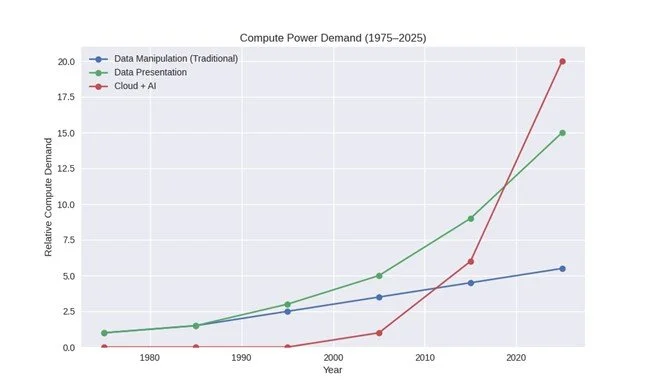
The following graph represents the various platforms for computing and how they have allocated computing power for business requirements.
1. Traditional Data Processing: The Quiet Workhorse
This is the compute that powers the systems organizations rely on every day—financial transactions, inventory management, claims processing, reservations, and other mission‑critical operations. Its growth has been steady and predictable for decades.
This is why mainframes remain deeply embedded in global industries. They excel at stability, security, and transactional integrity. They aren’t legacy; they’re purpose‑built for the part of the business that cannot afford to fail. Data is manipulated, stored, accessed, and distributed across an enterprise level of function.
2. Data Presentation: The Human Interface Layer
As technology became more visual, interactive, and mobile, the compute resources required to support user experiences grew dramatically. Modern interfaces—whether on a laptop, smartphones, or emerging AR/VR devices—demand significant local processing power for presentation to users. Supporting executive decisions has become more pronounced and demanded as the enterprise function in traditional data processing is used for information across business disciplines resulting in powerful knowledge practices.
This is why local devices continue to get more powerful, not less. The front end is where customers and employees experience your business. Responsiveness, personalization, and multimodal interaction all depend on strong client‑side compute power.
3. Cloud + AI: The New Engine of Scale
The most dramatic growth curve comes from cloud and AI workloads. Over the last fifteen years, distributed computing, big‑data pipelines, and machine learning have driven an exponential rise in compute demand. Truly wise capabilities are now possible with the assistance of Artificial Intelligence is assisting business leaders to make meaningful decisions.
This is the domain of hyperscale data centers, where organizations tap into massive parallel processing, specialized accelerators, and global infrastructure. AI training and inference are now the fastest‑growing consumers of compute in the world.
The Strategic Insight: Modern Computing Is Layered, Not Linear
Executives often ask whether the future belongs to the cloud, the edge, or centralized systems. The truth is that each layer exists because it solves a different business problem:
Mainframes support the systems that must be correct, consistent, and always available.
Local devices power the experiences that must be fast, intuitive, and personal.
Cloud and AI infrastructure handle the workloads that must scale, learn, and adapt.
These layers don’t replace one another. They reinforce one another. IT architecture needs to encompass all of the key computing elements of Mainframes, local devices and intelligent cloud processing.
Organizations that understand this layered model make better architectural decisions, avoid unnecessary migrations, and invest in the right capabilities at the right layer.
What This Means for the Future
The next decade will amplify these trends:
Cloud and AI compute will continue to accelerate, driven by larger models and more automation.
Local devices will become more capable, as more intelligence moves to the edge and interfaces become more immersive.
Mainframes will remain essential for industries where accuracy and reliability are non‑negotiable.
Efficiency and sustainability will become strategic priorities, as compute demand outpaces energy availability.
Talent strategies will shift, requiring teams who understand data systems, user experience, and AI‑driven distributed computing.
The organizations that thrive will be those that recognize computing as a multi‑layer ecosystem—and design their strategies accordingly.
What's your take? How do you think C-suite leaders adapt their strategies for information strategy to take advantage of the platforms available to them?